
- University
- Academic
- Schools/Vocational Schools
- Vocational School of Justice
- Vocational School
- Vocational School
- Department of Banking and Insurance (Turkish)
- Department of Computer Programming (Turkish)
- Department of Foreign Trade (Turkish)
- Department of Graphic Design (Turkish)
- Department of Interior Design (Turkish)
- Department of Construction Technology (Turkish)
- Department of Occupational Health and Safety (Turkish)
- Department of Media and Communication (Turkish)
- Department of Architectural Restoration (Turkish)
- Department of Radio and Tv Programming (Turkish)
- Department of Civil Aviation Cabin Services (Turkish)
- Department of Civil Aviation Transportation Management (Turkish)
- Department of Tourism and Hotel Management (Turkish)
- Department of Applied English Translation
- Vocational School Of Health Services
- Vocational School Of Health Services
- Department of Child Development (Turkish)
- Department of Physiotherapy (Turkish)
- Department of Paramedic (Turkish)
- Department of Opticianry (Turkish)
- Department of Medical Documentation and Secreteriat (Turkish)
- Department of Medical Imaging Techniques (Turkish)
- Department of Medical Laboratory Techniques (Turkish)
- Department of Elderly Care (Turkish)
- School of Applied Management Sciences
- School of Foreign Languages
- Faculties
- Faculty of Arts and Sciences
- Faculty of Fine Arts and Design
- Faculty of Law
- Faculty of Communication
- Faculty of Business
- Faculty of Engineering
- Faculty of Engineering
- Department of Computer Engineering
- Department of Biomedical Engineering
- Department of Electrical and Electronics Engineering
- Department of Industrial Engineering
- Department of Food Engineering
- Department of Genetics and Bioengineering
- Department of Aerospace Engineering
- Department of Civil Engineering
- Department of Mechanical Engineering
- Department of Mechatronics Engineering
- Department of Software Engineering
- Faculty of Health Sciences
- Medicine
- Graduate School
- Common Courses
- Schools/Vocational Schools
- Research
- Research Centers
- Library
- Smart Campus
- Technology Transfer Office
- İzmir Sciencepark
- Continuous Education Center (EKOSEM)
- Children's University
- Ethics Committee
- Teaching and Learning Center (EKOEĞİTİM)
- Psychology Application and Research Center
- Researcher Training Coordinatorship
- Research Collaborations And Innovation Coordinatorship
- Campus
- INTERNATIONAL
- Contact
- 25TH YEAR
Department of New Media and Communication
NMC 469 | Course Introduction and Application Information
| Course Name |
Media Literacy
|
|
Code
|
Semester
|
Theory
(hour/week) |
Application/Lab
(hour/week) |
Local Credits
|
ECTS
|
|
NMC 469
|
Fall/Spring
|
3
|
0
|
3
|
5
|
| Prerequisites |
None
|
|||||
| Course Language |
English
|
|||||
| Course Type |
Elective
|
|||||
| Course Level |
First Cycle
|
|||||
| Mode of Delivery | - | |||||
| Teaching Methods and Techniques of the Course | - | |||||
| National Occupation Classification | - | |||||
| Course Coordinator | - | |||||
| Course Lecturer(s) | ||||||
| Assistant(s) | - | |||||
| Course Objectives | The course focuses on making sense of the relation between media, culture, society and politics. Throughout the course, the students are encouraged to critically scrutinize the ways in which media have an impact on public opinion and our everyday cultural practices. |
| Learning Outcomes |
The students who succeeded in this course;
|
| Course Description | This course aims to increase the students’ appreciation of various forms of texts in a variety of media, such as film, television, news, social media, music etc. Furthermore, the course is geared towards guiding students in adopting a critical perspective in their engagements with media texts. |
| Related Sustainable Development Goals |
|
|
|
Core Courses | |
| Major Area Courses | ||
| Supportive Courses |
X
|
|
| Media and Management Skills Courses | ||
| Transferable Skill Courses |
WEEKLY SUBJECTS AND RELATED PREPARATION STUDIES
| Week | Subjects | Related Preparation |
| 1 | Introduction to the course | |
| 2 | The historical development of mass media and digitalization | Gregory, Karen, Tressie McMillan Cottom, and Jessie Daniels. 2017. Introduction, from Digital Sociologies. Beer, D., & Burrows, R. (2013). Popular culture, digital archives and the new social life of data. Theory, culture & society, 30(4), 47-71. |
| 3 | Introducing key concepts and types of literacy: Similarities and differences | Wuyckens, G., Landry, N., & Fastrez, P. (2022). Untangling media literacy, information literacy, and digital literacy: A systematic meta-review of core concepts in media education. Journal of Media Literacy Education, 14(1), 168-182. Polanco-Levicán, K., & Salvo-Garrido, S. (2022). Understanding social media literacy: A systematic review of the concept and its competences. International journal of environmental research and public health, 19(14), 8807. Hobbs, R. (Ed.). (2016). Exploring the roots of digital and media literacy through personal narrative. Temple University Press. |
| 4 | Media and politics: The political economy of new media, digital democracy and digital public sphere | Eisenegger, M., & Schäfer, M. S. (2023). Reconceptualizing public sphere (s) in the digital age? On the role and future of public sphere theory. Communication Theory, 33(2-3), 61-69. Klinger, U., Kreiss, D., & Mutsvairo, B. (2023). Platforms, power, and politics: An introduction to political communication in the digital age. John Wiley & Sons. Shah, V., Sivitanides, M., & Mehta, M. (2013). The era of digital activism. International Journal of Information Technology, Communications and Convergence, 2(4), 295-307. |
| 5 | The problem of false information in the digital age I: Definations and motivations of production | Tandoc, E., Lim, Z. W. ve Ling R. (2017). Defining ‘Fake News’: A Typology of Scholarly Definitions. Digital Journalism, 6(2), 137-153. Pérez-Escolar, M., Lilleker, D., & Tapia-Frade, A. (2023). A systematic literature review of the phenomenon of disinformation and misinformation. Media and communication, 11(2), 76-87. Kim, B., Xiong, A., Lee, D. ve Han, K. (2021). A Systematic Review on Fake News Research Through the Lens of News Creation and Consumption: Research Efforts, Challenges, and Future Directions. PloS one, 16(12). |
| 6 | The problem of false information in the digital age II: Dissemination of false information | Hameleers, M., & van der Meer, G. L. A. (2026). Misinformation according to news audiences: what do audiences in the U.S. and the Netherlands characterize as misinformation versus credible information on climate change. International Journal of Public Opinion Research, 38. Hameleers, M. (2024). Why Do Social Media Users Accept, Doubt or Resist Corrective Information? A Qualitative Analysis of Comments in Response to Corrective Information on Social Media. Journalism Studies, 25(7), 776-793. Allcott, H., Gentzkow, M. ve Yu, C. (2019). Trends in the Diffusion of Misinformation on Social Media. Research and Politics, 6(2). |
| 7 | Algorithms and platform capitalism | Diaz Ruiz C. ve Nilsson T. (2023) Disinformation and Echo Chambers: How Disinformation Circulates on Social Media Through Identity-driven Controversies. Journal of Public Policy & Marketing, 42(1): 18–35. Srnicek, N. (2017). Platform capitalism. John Wiley & Sons. |
| 8 | Midterm Exam | |
| 9 | Big data, digital surveillance and privacy | Kitchin, R. and McArdle, G. (2016) What makes Big Data, Big Data? Exploring the ontological characteristics of 26 datasets, Big Data and Society. Brayne, Sarah. 2017. “Big Data Surveillance: The Case of Policing.” American Sociological Review 82(5):977–1008. |
| 10 | The problem of false information in the digital age III: Methods for combating false information | Riazi, D., & Livan, G. (2026). Who should fight the spread of fake news?. Physica A: Statistical Mechanics and its Applications, 131396. Hameleers, M., & van der Meer, T. (2026). Striking the balance between fake and real: Under what conditions can media literacy messages that warn about misinformation maintain trust in accurate information? Behaviour and Information Technology, 45(7), 1209-1221. Alon, A. T., Rahimi, I. D. ve Tahar, H. (2024). Fighting Fake News on Social Media: A Comparative Evaluation of Digital Literacy Interventions. Current Psychology, 43(19), 17343-17361. |
| 11 | News literacy: Fact-checking and fact-checking sites | van Erkel, P. F. A., van Aelst, P., Van Nieuwenborgh, J., de Vreese, C. H., Hameleers, M., & Hopmann, D. N. (2026). Combating disinformation with news literacy interventions: An Experimental Study on the Framing Effects of News Literacy Messages. International Journal of Press/Politics, 31(1), 140-160. Tulin, M., Hameleers, M., de Vreese, C., Aalberg, T., Corbu, N., van Erkel, P., Esser, F., Gehle, L., Halagiera, D., Hopmann, D. N., Koc-Michalska, K., Matthes, J., Mihelj, S., Schemer, C., Stetka, V., Strömbäck, J., Terren, L., & Theocharis, Y. (2025). Why do Citizens Choose to Read Fact-Checks in the Context of the Russian War in Ukraine? The Role of Directional and Accuracy Motivations in Nineteen Democracies. The International Journal of Press/Politics, 30(3), 679-704. Wouters, F., Opgenhaffen, M., Tulin, M., & Hameleers, M. (2025). Claim negations vs. fact affirmations: Evidence of the content and effects of fact-check headlines. Journalism Practice. Advance online publication. |
| 12 | AI literacy | Dobber, T., Hameleers, M., Starke, C., & van der Meer, T. (2025). Generative AI and Disinformation : A Beacon of Trustworthiness in a Sea of Disinformation: Does News Coverage About the Dangers of Generative AI Cause People to Flock to Journalism? International Journal of Communication : IJoC, 19, 3691–3711. Yim, I. H. Y. (2024). A critical review of teaching and learning artificial intelligence (AI) literacy: Developing an intelligence-based AI literacy framework for primary school education. Computers and education: artificial intelligence, 7, 100319. Almatrafi, O., Johri, A., & Lee, H. (2024). A systematic review of AI literacy conceptualization, constructs, and implementation and assessment efforts (2019–2023). Computers and Education Open, 6, 100173. |
| 13 | Advertising literacy: The digitalization of consumer culture | Yoo, J. A., & Cho, C. H. (2025). What is digital advertising literacy? Its components and relationship with advertising effectiveness and personal factors. Journal of Global Scholars of Marketing Science, 35(4), 633-654. Feijoo, B., Zozaya, L., & Sádaba, C. (2023). Do I question what influencers sell me? Integration of critical thinking in the advertising literacy of Spanish adolescents. Humanities and Social Sciences Communications, 10(1), 363. Airoldi, M., & Rokka, J. (2022). Algorithmic consumer culture. Consumption Markets & Culture, 25(5), 411-428. |
| 14 | Student presentations | |
| 15 | Semester Review | |
| 16 | Final Exam |
| Course Notes/Textbooks | Potter, W. James (2005) Media Literacy. Thousand Oaks, CA : Sage, ISBN-ISSN 1-4129-0989-9 |
| Suggested Readings/Materials |
EVALUATION SYSTEM
| Semester Activities | Number | Weigthing |
| Participation |
1
|
10
|
| Laboratory / Application | ||
| Field Work | ||
| Quizzes / Studio Critiques |
2
|
10
|
| Portfolio | ||
| Homework / Assignments | ||
| Presentation / Jury |
1
|
20
|
| Project |
1
|
30
|
| Seminar / Workshop | ||
| Oral Exams | ||
| Midterm |
1
|
30
|
| Final Exam | ||
| Total |
| Weighting of Semester Activities on the Final Grade |
6
|
100
|
| Weighting of End-of-Semester Activities on the Final Grade | ||
| Total |
ECTS / WORKLOAD TABLE
| Semester Activities | Number | Duration (Hours) | Workload |
|---|---|---|---|
| Theoretical Course Hours (Including exam week: 16 x total hours) |
16
|
3
|
48
|
| Laboratory / Application Hours |
16
|
0
|
|
| Study Hours Out of Class |
14
|
2
|
28
|
| Field Work |
0
|
||
| Quizzes / Studio Critiques |
2
|
4
|
8
|
| Portfolio |
0
|
||
| Homework / Assignments |
0
|
||
| Presentation / Jury |
1
|
14
|
14
|
| Project |
1
|
28
|
28
|
| Seminar / Workshop |
0
|
||
| Oral Exam |
0
|
||
| Midterms |
1
|
24
|
24
|
| Final Exam |
0
|
||
| Total |
150
|
COURSE LEARNING OUTCOMES AND PROGRAM QUALIFICATIONS RELATIONSHIP
|
#
|
Program Competencies/Outcomes |
* Contribution Level
|
|||||
|
1
|
2
|
3
|
4
|
5
|
|||
| 1 |
To be able to critically discuss and interpret the theories, concepts and ideas that form the basis of the discipline of new media and communication. |
-
|
-
|
-
|
-
|
-
|
|
| 2 |
To be able to critically interpret theoretical debates concerning the relations between the forms, agents, and factors that play a role in the field of new media and communication. |
-
|
-
|
-
|
X
|
-
|
|
| 3 |
To have the fundamental knowledge and ability to use the technical equipment and software programs required by the new media production processes. |
-
|
-
|
-
|
-
|
-
|
|
| 4 |
To be able to gather, scrutinize and scientifically investigate data in the processes of production and distribution. |
-
|
-
|
-
|
-
|
-
|
|
| 5 |
To be able to use the acquired theoretical knowledge in practice. |
-
|
X
|
-
|
-
|
-
|
|
| 6 |
To be able to take responsibility both individually and as a member of a group to develop solutions to problems encountered in the field of new media and communication. |
-
|
-
|
-
|
-
|
-
|
|
| 7 |
To be informed about national, regional, and global issues and problems; to be able to generate problem-solving methods depending on the quality of evidence and research, and to acquire the ability to report the conclusions of those methods to the public. |
-
|
-
|
-
|
-
|
-
|
|
| 8 |
To be able to critically discuss and draw on theories, concepts and ideas that form the basis of other disciplines complementing the field of new media and communication studies. |
-
|
-
|
-
|
-
|
-
|
|
| 9 |
To be able to develop and use knowledge and skills towards personal and social goals in a lifelong process. |
-
|
-
|
-
|
X
|
-
|
|
| 10 |
To be able to apply social, scientific and professional ethical values in the field of new media and communication. |
-
|
-
|
-
|
-
|
-
|
|
| 11 |
To be able to collect datain the areas of new media and communication and communicate with colleagues in a foreign language ("European Language Portfolio Global Scale", Level B1). |
-
|
-
|
-
|
-
|
-
|
|
| 12 |
To be able to speak a second foreign language at a medium level of fluency efficiently. |
-
|
-
|
-
|
-
|
-
|
|
| 13 |
To be able to relate the knowledge accumulated throughout the human history to their field of expertise. |
-
|
-
|
-
|
-
|
-
|
|
*1 Lowest, 2 Low, 3 Average, 4 High, 5 Highest




NEWSALL NEWS


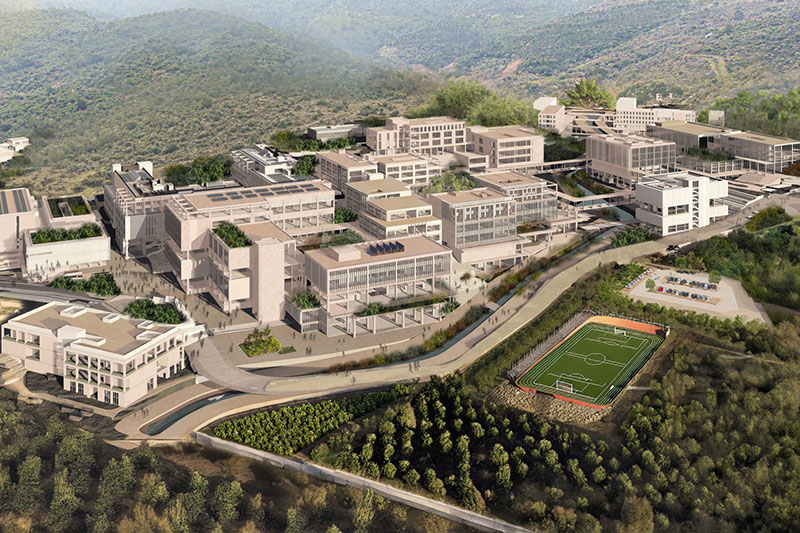
IZMIR UNIVERSITY OF ECONOMICS GÜZELBAHÇE CAMPUS
DetailsGLOBAL CAREER
As Izmir University of Economics transforms into a world-class university, it also raises successful young people with global competence.
More..CONTRIBUTION TO SCIENCE
Izmir University of Economics produces qualified knowledge and competent technologies.
More..VALUING PEOPLE
Izmir University of Economics sees producing social benefit as its reason for existence.
More..
You are one step ahead with your graduate education at Izmir University of Economics.