

- University
- Academic
- Schools/Vocational Schools
- Vocational School of Justice
- Vocational School
- Vocational School
- Department of Banking and Insurance (Turkish)
- Department of Computer Programming (Turkish)
- Department of Foreign Trade (Turkish)
- Department of Graphic Design (Turkish)
- Department of Interior Design (Turkish)
- Department of Construction Technology (Turkish)
- Department of Occupational Health and Safety (Turkish)
- Department of Media and Communication (Turkish)
- Department of Architectural Restoration (Turkish)
- Department of Radio and Tv Programming (Turkish)
- Department of Civil Aviation Cabin Services (Turkish)
- Department of Civil Aviation Transportation Management (Turkish)
- Department of Tourism and Hotel Management (Turkish)
- Department of Applied English Translation
- Vocational School Of Health Services
- Vocational School Of Health Services
- Department of Child Development (Turkish)
- Department of Physiotherapy (Turkish)
- Department of Paramedic (Turkish)
- Department of Opticianry (Turkish)
- Department of Medical Documentation and Secreteriat (Turkish)
- Department of Medical Imaging Techniques (Turkish)
- Department of Medical Laboratory Techniques (Turkish)
- Department of Elderly Care (Turkish)
- School of Applied Management Sciences
- School of Foreign Languages
- Faculties
- Faculty of Arts and Sciences
- Faculty of Fine Arts and Design
- Faculty of Law
- Faculty of Communication
- Faculty of Business
- Faculty of Engineering
- Faculty of Engineering
- Department of Computer Engineering
- Department of Biomedical Engineering
- Department of Electrical and Electronics Engineering
- Department of Industrial Engineering
- Department of Food Engineering
- Department of Genetics and Bioengineering
- Department of Aerospace Engineering
- Department of Civil Engineering
- Department of Mechanical Engineering
- Department of Mechatronics Engineering
- Department of Software Engineering
- Faculty of Health Sciences
- Medicine
- Graduate School
- Common Courses
- Schools/Vocational Schools
- Research
- Research Centers
- Library
- Smart Campus
- Technology Transfer Office
- İzmir Sciencepark
- Continuous Education Center (EKOSEM)
- Children's University
- Ethics Committee
- Teaching and Learning Center (EKOEĞİTİM)
- Psychology Application and Research Center
- Researcher Training Coordinatorship
- Research Collaborations And Innovation Coordinatorship
- Campus
- INTERNATIONAL
- Contact
- 25TH YEAR
Department of New Media and Communication
NMC 302 | Course Introduction and Application Information
| Course Name |
Ethics
|
|
Code
|
Semester
|
Theory
(hour/week) |
Application/Lab
(hour/week) |
Local Credits
|
ECTS
|
|
NMC 302
|
Spring
|
2
|
2
|
3
|
5
|
| Prerequisites |
None
|
|||||
| Course Language |
English
|
|||||
| Course Type |
Required
|
|||||
| Course Level |
First Cycle
|
|||||
| Mode of Delivery | face to face | |||||
| Teaching Methods and Techniques of the Course | DiscussionGroup WorkCase StudyLecture / Presentation | |||||
| National Occupation Classification | - | |||||
| Course Coordinator | ||||||
| Course Lecturer(s) | ||||||
| Assistant(s) | - | |||||
| Course Objectives | This course aims to equip students with the conceptual tools necessary to analyze and evaluate the ethical issues arising in communication contexts involving new and old media. Particular emphasis will be placed on exercises designed to apply these concepts and reasoning procedures to concrete situations. |
| Learning Outcomes |
The students who succeeded in this course;
|
| Course Description | This course provides an introduction to fundamental ethical paradigms in ethical thinking and evaluation in order to deliberate on and engage with ethical conflict in media old and new. Students will be expected to actively discuss and debate and participate in in-class group projects.;Students will learn the relationship between general theories and the analysis of particular problem by performing exercises tha emphasize he problems of application. |
| Related Sustainable Development Goals |
|
|
|
Core Courses |
X
|
| Major Area Courses | ||
| Supportive Courses | ||
| Media and Management Skills Courses | ||
| Transferable Skill Courses |
WEEKLY SUBJECTS AND RELATED PREPARATION STUDIES
| Week | Subjects | Related Preparation |
| 1 | Introduction: What is Ethics? | Sharman, “How to watch a movie”: https://uark.pressbooks.pub/movingpictures/chapter/how-to-watch-a-movie/ |
| 2 | Virtue Ethics - Character, eudaimonia, habituation, the mean | |
| 3 | Divine command and the problem of evil - Natural law, guilt, retribution, theodicy | |
| 4 | Utilitarianism and contract - Consequentialism, aggregate harm, higher and lower pleasures, the social contract | |
| 5 | Kantian Ethics — Deontology - The categorical imperative, the formula of humanity, autonomy, dignity, rights | |
| 6 | Existentialist Ethics - Ressentiment, master and slave morality, radical freedom, bad faith, authenticity | |
| 7 | Ethics and the Other - Levinas and the face; Foucault on power, discourse and biopolitics; feminist ethics and the ethics of care; systemic versus individual responsibility. | |
| 8 | Midterm Exam | |
| 9 | Ethics of Spectatorship | Susan Sontag, Regarding the Pain of Others. |
| 10 | Sex, Gender and the Gaze | bell hooks, "The Oppositional Gaze." |
| 11 | Speciesism and the Non-Human | Peter Singer, Animal Liberation, ch. 1 ("All Animals Are Equal") |
| 12 | Climate | Amitav Ghosh, The Great Derangement — excerpt. |
| 13 | AI | “Coercion, consent and the struggle for social media” in Routledge Handbook of Mass Media Ethics; “Holocaust denial, cyberspace, and the question of moral convergence” in Ethics of Emerging Media. |
| 14 | End Times Ethics (December 25) | Naomi Klein and Astra Taylor, End Times Fascism. Farrar, https://www.youtube.com/watch?v=aK2nLNiFEAQ |
| 15 | Review of the semester | |
| 16 | Final Exam Week |
| Course Notes/Textbooks | 1. Digital Media Ethics, Charles Ess ed., 2 nd ed. Polity Press 2014. ISBN-10: 0745656064 2. Routledge Handbook of Mass Media Ethics, Lee Wilkins and Clifford G. Christians, 2 nd ed, Routledge 2020. ISBN- 10: 9780805861914 |
| Suggested Readings/Materials | Christopher Falzon, Ethics Goes to the Movies: An Introduction to Moral Philosophy. Routledge, 2019. Russ Shafer-Landau, Living Ethics: An Introduction with Readings. Oxford UP, 2019. Julia Baggini and Peter S. Fosl, The Ethics Toolkit: A Compendium of Ethical Concepts and Methods. Blackwell Publishing, 2007. |
EVALUATION SYSTEM
| Semester Activities | Number | Weigthing |
| Participation |
1
|
20
|
| Laboratory / Application | ||
| Field Work | ||
| Quizzes / Studio Critiques | ||
| Portfolio | ||
| Homework / Assignments |
1
|
40
|
| Presentation / Jury |
1
|
40
|
| Project | ||
| Seminar / Workshop | ||
| Oral Exams | ||
| Midterm | ||
| Final Exam | ||
| Total |
| Weighting of Semester Activities on the Final Grade |
4
|
100
|
| Weighting of End-of-Semester Activities on the Final Grade | ||
| Total |
ECTS / WORKLOAD TABLE
| Semester Activities | Number | Duration (Hours) | Workload |
|---|---|---|---|
| Theoretical Course Hours (Including exam week: 16 x total hours) |
16
|
2
|
32
|
| Laboratory / Application Hours (Including exam week: '.16.' x total hours) |
16
|
2
|
32
|
| Study Hours Out of Class |
14
|
3
|
42
|
| Field Work |
0
|
||
| Quizzes / Studio Critiques |
0
|
||
| Portfolio |
0
|
||
| Homework / Assignments |
2
|
13
|
26
|
| Presentation / Jury |
1
|
17
|
17
|
| Project |
0
|
||
| Seminar / Workshop |
0
|
||
| Oral Exam |
0
|
||
| Midterms |
0
|
||
| Final Exam |
0
|
||
| Total |
149
|
COURSE LEARNING OUTCOMES AND PROGRAM QUALIFICATIONS RELATIONSHIP
|
#
|
Program Competencies/Outcomes |
* Contribution Level
|
|||||
|
1
|
2
|
3
|
4
|
5
|
|||
| 1 |
To be able to critically discuss and interpret the theories, concepts and ideas that form the basis of the discipline of new media and communication. |
-
|
-
|
-
|
-
|
-
|
|
| 2 |
To be able to critically interpret theoretical debates concerning the relations between the forms, agents, and factors that play a role in the field of new media and communication. |
-
|
-
|
-
|
-
|
-
|
|
| 3 |
To have the fundamental knowledge and ability to use the technical equipment and software programs required by the new media production processes. |
-
|
-
|
-
|
-
|
-
|
|
| 4 |
To be able to gather, scrutinize and scientifically investigate data in the processes of production and distribution. |
-
|
-
|
-
|
-
|
-
|
|
| 5 |
To be able to use the acquired theoretical knowledge in practice. |
-
|
-
|
-
|
-
|
-
|
|
| 6 |
To be able to take responsibility both individually and as a member of a group to develop solutions to problems encountered in the field of new media and communication. |
-
|
-
|
-
|
-
|
-
|
|
| 7 |
To be informed about national, regional, and global issues and problems; to be able to generate problem-solving methods depending on the quality of evidence and research, and to acquire the ability to report the conclusions of those methods to the public. |
-
|
-
|
-
|
-
|
-
|
|
| 8 |
To be able to critically discuss and draw on theories, concepts and ideas that form the basis of other disciplines complementing the field of new media and communication studies. |
-
|
-
|
-
|
X
|
-
|
|
| 9 |
To be able to develop and use knowledge and skills towards personal and social goals in a lifelong process. |
-
|
-
|
X
|
-
|
-
|
|
| 10 |
To be able to apply social, scientific and professional ethical values in the field of new media and communication. |
-
|
-
|
-
|
-
|
X
|
|
| 11 |
To be able to collect datain the areas of new media and communication and communicate with colleagues in a foreign language ("European Language Portfolio Global Scale", Level B1). |
-
|
-
|
-
|
-
|
-
|
|
| 12 |
To be able to speak a second foreign language at a medium level of fluency efficiently. |
-
|
-
|
-
|
-
|
-
|
|
| 13 |
To be able to relate the knowledge accumulated throughout the human history to their field of expertise. |
-
|
-
|
-
|
-
|
-
|
|
*1 Lowest, 2 Low, 3 Average, 4 High, 5 Highest




NEWSALL NEWS


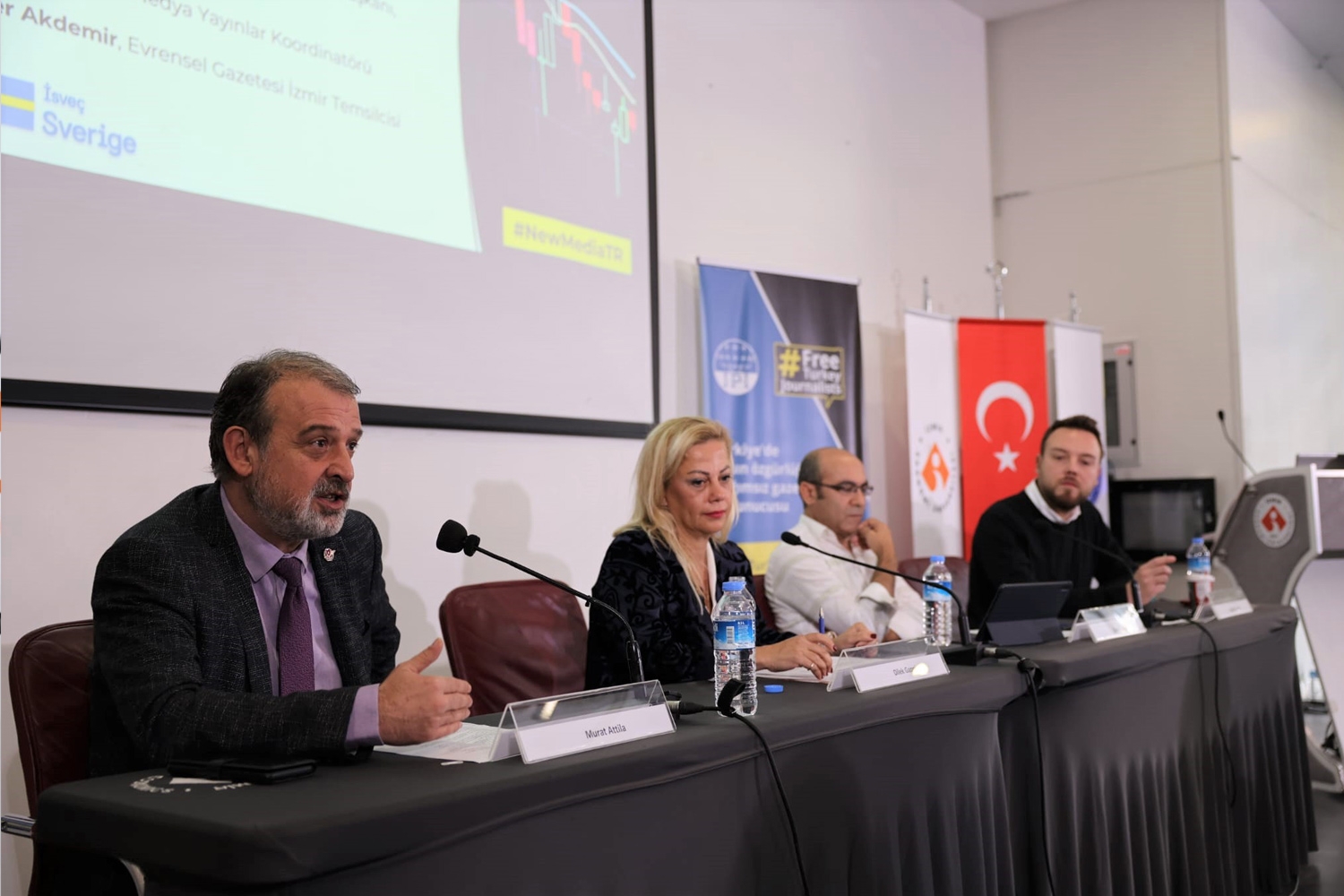

IZMIR UNIVERSITY OF ECONOMICS GÜZELBAHÇE CAMPUS
DetailsGLOBAL CAREER
As Izmir University of Economics transforms into a world-class university, it also raises successful young people with global competence.
More..CONTRIBUTION TO SCIENCE
Izmir University of Economics produces qualified knowledge and competent technologies.
More..VALUING PEOPLE
Izmir University of Economics sees producing social benefit as its reason for existence.
More..
You are one step ahead with your graduate education at Izmir University of Economics.